When you describe your business, do you use the same words your customers use?
Most business owners know their industry terminology. They understand the official names of their services, processes, and products. But those may not be the words potential customers type into a search bar or use when explaining what they need.
Industry language is not necessarily wrong. You do not have to remove it completely. But if your marketing relies only on words your audience does not recognize or use, it becomes harder for people to understand how you can help them.
Good marketing creates connection. One of the simplest ways to create that connection is to use language that already resonates with your audience.
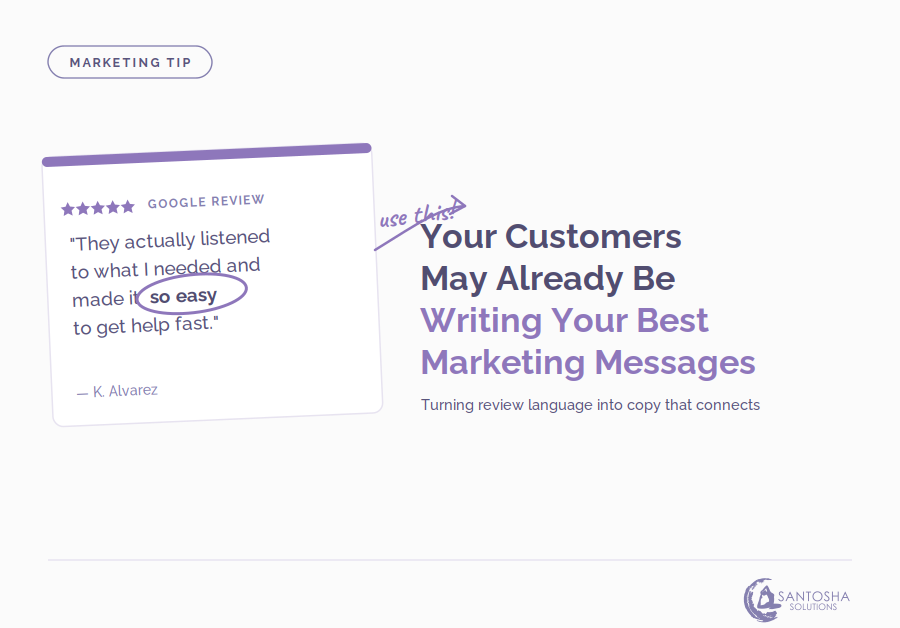
Fortunately, your customers may already be giving you that language in their reviews.
Reviews are more than testimonials
Businesses often see reviews primarily as a way to build credibility. A collection of positive reviews can certainly help a potential customer feel more confident about choosing you.
But reviews can also be a valuable source of customer research.
When customers write reviews, they often describe:
- What they valued about their experience
- What problem they needed to solve
- Why they chose the business
- How the product or service helped them
- What made the experience memorable
- What frustrated or disappointed them
- The words they naturally use when talking about the business
These insights can help you understand what matters to customers instead of relying only on what you assume matters to them.
Create a review spreadsheet
Start by collecting reviews from the platforms that are relevant to your business. These might include:
- Yelp
- Industry-specific websites or applications
- Other platforms where customers review businesses like yours
Create a spreadsheet with columns for:
- Date
- Star rating
- Review
- Reviewer’s name, if you want it for your internal records
The reviewer’s name can be helpful if you use the spreadsheet for other purposes, such as identifying people you may want to thank or contact. However, remove names and other personally identifying details from the information you provide to an AI tool.
Once you have collected your reviews, you can use AI to help identify patterns that may be difficult to notice while reading one review at a time.
Use AI to find recurring customer language
Copy the review text, without reviewer names or personal information, into your preferred AI tool. You can adapt the following prompt for your business:
AI prompt:
Act as a customer-insights researcher for [business name or type of business].
Analyze the customer reviews I provide as a group. Do not evaluate the reviewers individually.
Identify:
- Frequently repeated words and phrases
- The qualities customers value most
- The problems or needs customers mention
- The positive experiences that appear to influence satisfaction
- Recurring frustrations, complaints, or service gaps
- The outcomes customers describe after using the product or service
- Words customers use that could help this business create clearer, more relatable marketing messages
Organize the findings into themes. Explain how often each theme appears and include short, anonymous examples from the reviews. Do not invent information or make assumptions that are not supported by the reviews.
Finally, suggest ways these customer words and themes could be used in website copy, service descriptions, newsletters, Google Business Profile content, and social media posts.
AI can help organize the information, but you still need to review the results. Look at the original reviews and confirm that the findings accurately reflect what customers said.
What if you do not have many reviews?
You can still use this exercise.
Study reviews for businesses that offer similar products or services. Look at both positive and negative reviews to understand:
- What customers value
- What they wish businesses did differently
- What concerns appear before or after a purchase
- How customers describe the problem they are trying to solve
- Opportunities to improve your own customer experience
The goal is not to copy a competitor’s marketing or claim their customers’ experiences as your own. The goal is to better understand the language, expectations, and concerns that exist in your market.
Turn customer insights into better marketing
Once you identify recurring words and themes, do not leave them sitting in the spreadsheet.
Use what you learn throughout your marketing, including:
- Website headings and service pages
- Product and service descriptions
- Blog posts
- Newsletters
- Google Business Profile posts
- Social media content
- Frequently asked questions
- Sales conversations
This does not mean copying an entire review and turning it into an advertisement. It means paying attention to how customers naturally describe their needs, experiences, and desired results.
When people encounter familiar language in your marketing, it is easier for them to recognize that your message is relevant to them.
You are not simply trying to sound clever or professional. You are helping the right people find you, understand you, and feel that you understand them.
Because if your message is not connecting with your audience, it becomes much harder for your business to be found, grow, and thrive.

Hi! I’m Carolyn. I work with solopreneurs and small business owners to clarify their message and grow their business through digital marketing and social media coaching. If you’re ready to connect with your ideal audience and build a business that supports a life you love, let’s talk.